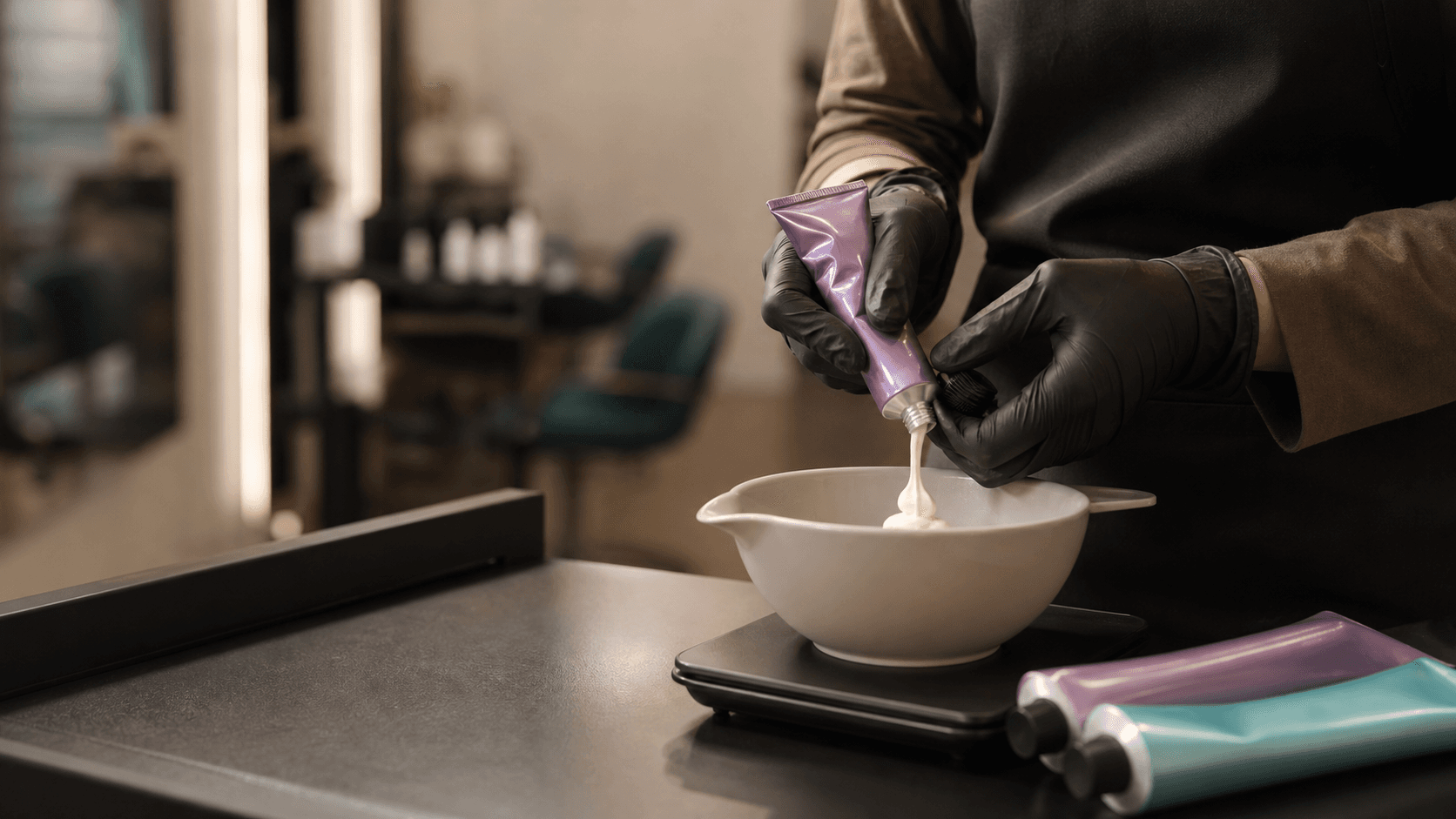
Colour service profitability
Where does money really disappear in colour services?
A full calendar does not guarantee a high profit. Many salons are fully booked and still ask at the end of the month why so many colour services created less profit than expected.
Where does a salon most often lose money?
The largest losses rarely come from one expensive mistake. They usually come from many small situations repeated every day.
The work carried out during a colour service creates costs that are not visible in the calendar or monthly revenue. A few extra grams, leftover colour, another toner or an unknown service cost can look insignificant on its own, but together they can materially reduce profitability.
The most common sources are excess preparation, small weighing differences, leftover mixes, corrections, unclear inventory movement, idealised pricing and differences in the team's working methods.
Seven common sources of waste
| Source of waste | Why it matters |
|---|---|
| Product prepared just in case | It regularly increases material usage. |
| Small weighing differences | A few grams per service become kilograms over a month. |
| Leftover mixes | The same oversupply is repeated on future visits. |
| Corrections during a service | Each extra mix increases the service cost. |
| No inventory visibility | It is difficult to see where products go. |
| Pricing an ideal service | The calculation ignores normal deviations and corrections. |
| Different team habits | The same colour service can cost different amounts. |
1. Product prepared just in case
Preparing more product than the service really needs is one of the most common sources of waste. A reserve is not the problem by itself. The problem starts when it becomes a daily habit.
Hair density, length or the need for stronger saturation can make a stylist prepare a little extra rather than risk running out. That is understandable, but repeated leftovers mean the salon buys more product than it actually uses.
The important question is not whether too much was prepared once. It is how often this happens and whether the next service can start with better information.
2. A few extra grams look small until you count the month
Small differences while weighing products are hard to notice because they happen during fast, precise work. If a salon completes 200 colour services a month and uses only 3 g more product on each service, that is already 600 g of unplanned product usage — the equivalent of ten 60 g tubes.
This is not about proving that someone made a mistake. Small deviations are a natural part of colour work. The useful question is how often they appear in real salon work and what they do to the service cost.
3. Leftover mixes return at every next appointment
The first colour service always includes uncertainty. It is not yet clear how the hair will react, how much product will be needed or whether another portion will be necessary.
If 10 g is left in the bowl after each of 180 monthly services, the salon throws away 1.8 kg of product every month. The next appointment often starts with a similar amount because nobody recorded that the previous mix was too large.
Recording whether the prepared amount was appropriate helps reduce the same waste over time.
Example: leftover mix in one month
| Data | Value |
|---|---|
| Colour services per month | 180 |
| Average leftover mix | 10 g |
| Total unused product | 1.8 kg per month |
4. Corrections cost more than they seem
Every correction adds material cost and working time. Additional toning, a lightening bath or another mix can be a normal part of colour work, but the cost of these stages should still be visible in the profitability analysis.
A service may start with 90 g of colour, need another 60 g of toner, then require a lightening bath and a final toner. One such service does not look dramatic, but repeated corrections quickly increase the material cost.
Corrections also occupy the station. If a service takes 20–30 minutes longer, another appointment cannot start during that time. That is a profitability cost even if it does not appear on a product invoice.
5. Missing inventory visibility hides the source of waste
An inventory count shows what is missing, not why it disappeared. Without the actual product usage connected to each service, it is difficult to separate normal consumption from waste.
A salon may keep ordering more product even though the number of colour services stays stable. Usage data helps answer whether product was used during a service, left in the bowl or lost earlier while a formula was being recorded.
- Was the product actually used during the colour service?
- Does part of the mix regularly remain in the bowl?
- Are differences caused by more services or more product per service?
- Does the problem start when formulas are recorded?
6. Service pricing often assumes an ideal colour service
A price calculation often includes the formula amount, oxidant and basic disposable materials. It may not include weighing differences, extra mixes, leftovers or corrections that happen in everyday work.
Every one of these situations increases the delivery cost. If the price ignores them, the salon may assume its margin is higher than it really is.
The goal is not a perfect calculation. It is a realistic one that reflects how the salon actually works.
7. The same colour service can cost different amounts
The cost of a service depends not only on the formula but also on how it is performed. One stylist may prepare exactly what is needed, while another adds a reserve or prepares another portion during application.
These choices are made in good faith and reflect experience and individual working style. The point is not to judge who works better, but to understand that the real cost of the same service can differ.
Connecting product usage with specific services shows whether the current price still delivers the expected profitability.
How can you find the biggest sources of waste? Start with a simple audit
You do not have to change the whole salon at once. Start by observing colour services more closely for a few weeks.
Check whether you know the average material cost, the usual leftover amount, how often extra mixes or corrections occur, whether usage matches inventory and which services are most profitable.
If most answers are unclear, it does not mean the salon is doing something wrong. It usually means that the data needed to assess profitability is missing.
- the average material cost of one colour service,
- how much product usually remains after a service,
- how often an extra mix is prepared,
- the cost of corrections during the same appointment,
- whether actual usage matches inventory levels,
- the working-hour cost of one colour service,
- which services are most profitable and which create the highest cost.
How can you improve colour-service profitability?
Improving profitability does not always require higher prices. Better cost visibility and regular analysis often create a stronger first step.
Rising product prices can make salons look for cheaper orders or consider a new price list. Sometimes that is necessary, but price is only one side of the equation. The other side is what it really costs to deliver the service.
If the salon does not know how much product a service used, how often an extra mix was prepared or which services need the most corrections, it is difficult to make changes that genuinely improve profitability.
Start by organising the data before looking for savings at any cost.
What should you review regularly?
You do not need a complex financial report. Start with a few indicators that have the strongest effect on colour-service costs.
Reviewing these indicators can reveal that a service seen as highly profitable creates more material cost than the others, or that differences between team members are larger than the formula alone would suggest.
Useful indicators to monitor
| Indicator | Why monitor it? |
|---|---|
| Average material cost per service | Shows whether the margin matches the plan. |
| Unused mix | Shows whether the prepared amount is appropriate. |
| Corrections during a service | Shows additional material and time costs. |
| Actual product usage | Helps plan orders and find hidden waste. |
| Working-hour cost | Shows whether the price reflects the work required. |
Data supports better decisions
Salon owners know their industry and experience is valuable. The problem starts when experience is the only source of information.
If products seem to disappear faster, the cause might be price increases or more services — but it might also be larger mixes, more corrections or a change in team habits. Without data, assumptions and actual causes are hard to separate.
The goal is not to control every person or account for every gram. It is to understand everyday work and identify the processes with the greatest impact on profitability.
What should you remember?
Colour-service costs do not end with the price of colour and oxidant. Product differences, corrections, working time and everyday decisions all affect profitability.
Most of these costs are invisible during one appointment. Reviewing many colour services reveals repeated patterns and shows where losses really appear.
Dosiq helps salons analyse actual product usage, colour-service costs and profitability so owners can plan prices, orders and growth from data rather than assumptions.
All numerical examples in this article are hypothetical and are included to explain the mechanism.